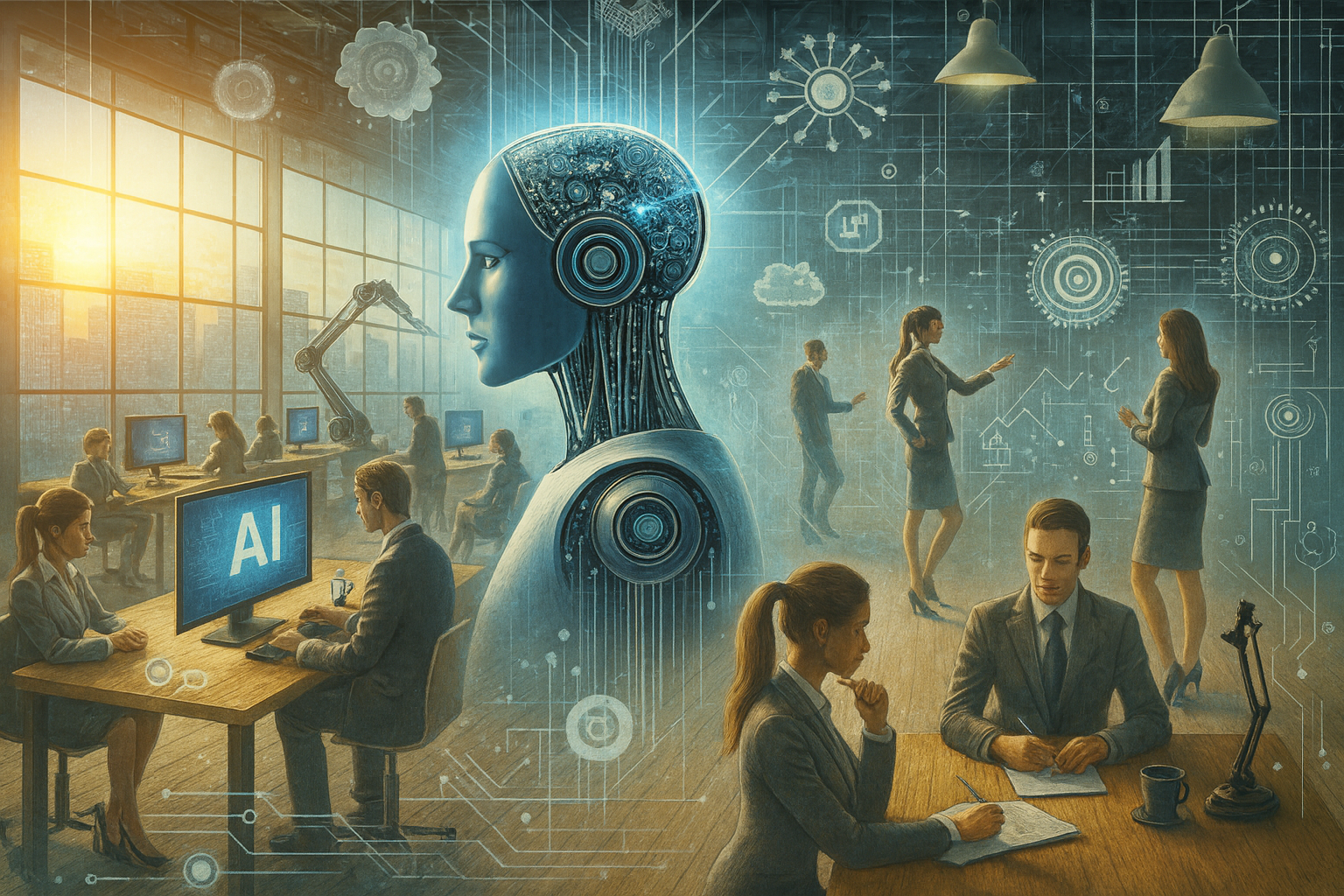
Artificial Intelligence (AI) is no longer a speculative technology, it is now deeply woven into the global economy, reshaping industries, transforming workflows, and redefining the skills that workers need to stay competitive. From automation in manufacturing to intelligent decision-making systems in finance, healthcare and logistics, AI is poised to become one of the most influential forces affecting the global workforce over the next decade. While many fear job losses, others see AI as a powerful enabler of innovation, productivity and entirely new job categories. Understanding these dynamics is essential for governments, businesses and workers to navigate the future of work. As intelligent systems become more capable of performing tasks traditionally done by humans, society faces a pressing question: How will AI affect jobs, the global workforce and employment? This article explores AI’s impact in this three major dimensions.
Impact of AI on Jobs
The relationship between AI and work is not simply about replacement, it’s about transformation, skill shifts, and the creation of entirely new career ecosystems. While some roles may disappear or shrink, many others will evolve, expand, or newly emerge.
1. Automation of Routine and Repetitive Tasks
One of the most significant ways AI affects jobs is through task automation, especially tasks that are predictable, structured, repetitive, or heavily rule-based. AI systems such as machine learning algorithms, chatbots, robotic process automation (RPA), and industrial robots can perform tasks faster, more accurately and at a lower operational cost than humans. In addition, AI can process information faster, without fatigue, and with fewer errors, making these roles particularly vulnerable.
Affected Job Categories
Automation is particularly common in occupations where tasks are standardized and don’t require deep creativity or complex human judgment. These include:
- Data entry and clerical positions: AI can enter, clean, sort, and analyze data more efficiently.
- Administrative support roles: Scheduling, record management, and correspondence can be automated.
- Basic customer service: Chatbots and virtual assistants now handle common inquiries.
- Assembly line and manufacturing: Robots perform repetitive physical tasks with precision.
- Simple bookkeeping and accounting tasks: AI systems classify transactions and detect patterns.
- Routine medical diagnostics: AI tools perform initial scans and flag anomalies in X-rays, MRIs, and lab results.
2. Transformation of Existing Jobs
Not all jobs will disappear many will evolve. AI will act as a ‘co-worker’, helping professionals work faster and better. Rather than replacing these professionals, AI enhances their productivity, allowing them to focus on higher-value tasks.
Examples of Transformed Professions
Human resource professionals: AI prescreens candidates and analyzes job-fit metrics, enabling HR teams to spend more time on employee development and engagement.
Doctors: AI assists with medical imaging, early diagnosis, treatment planning, and patient monitoring. Doctors can focus more on patient care, empathy, and complex medical decisions.
Lawyers: AI tools review contracts, perform legal research, and identify case patterns. Lawyers gain more time for litigation strategy and client interaction.
Teachers: AI helps personalize learning, track student performance, and design adaptive learning plans. Teachers can focus more on mentorship, creativity, and emotional support.
Marketing specialists: AI analyzes consumer behavior, predicts trends, and generates targeted advertising strategies, allowing marketers to focus on creativity and brand-building.
3. Creation of New Job Categories
Just like past technological revolutions, AI will create new roles that didn’t exist before. These roles require advanced digital and analytical skills, opening new career paths.
- AI trainers and data annotators: They help AI systems learn by labeling data, reviewing outputs, and training models.
- Machine learning engineers: Developers who design, build, and maintain AI algorithms.
- Prompt engineers: Specialists who craft effective prompts for AI systems to produce accurate results.
- AI ethicists and policy experts: Professionals who create guidelines for safe, fair and transparent AI use.
- Robot supervisors and technicians: Workers who maintain, repair, and oversee robots in manufacturing, logistics, and healthcare.
- Cybersecurity AI specialists: Experts who develop AI-powered security systems and respond to AI-driven cyber threats.
- AI content creators and digital designers: People who collaborate with AI tools to create media, art, or written content.
4. Increased Demand for Human-Centric Skills
As AI becomes more capable of performing cognitive and technical tasks, the value of human-centric abilities rises. These are skills that AI currently cannot fully replicate, especially those involving deep emotional intelligence, human interaction, creativity, and ethical judgment.
Human Skills That Become More Important
- Creativity: Designing, innovating and imagining new possibilities.
- Emotional intelligence: Understanding feelings, building relationships and managing interpersonal dynamics.
- Leadership and influence: Motivating, guiding and inspiring individuals or teams.
- Critical thinking: Evaluating complex information and making informed decisions.
- Complex problem-solving: Addressing unpredictable, multidimensional challenges.
5. Growing Demand for Jobs Involving Empathy and Human Interaction
AI cannot replace genuine human emotion, compassion, or physical presence. As a result, occupations that depend on these qualities will continue growing.
Examples include:
- Nursing and healthcare support
- Therapy and mental health services
- Social work
- Teaching and early childhood education
- Human resource management
- Customer relationship building
Creative arts and entertainment industries
2. Impact of AI on the Global Workforce
A Shift in Required Skill Sets
Globally, workers must adapt to new skill demands. Countries that invest in reskilling will benefit the most. AI adoption is transforming the skills workers need to stay relevant. Traditional competencies are no longer enough; workers must be adaptable and technologically fluent.
High-demand future skills
- AI literacy
- Data analysis
- Programming and automation tools
- Digital communication
- Adaptive learning
- Interdisciplinary decision-making
Workforce Polarization
AI’s rapid growth may widen the gap between high-skill and low-skill workers. This polarization may cause economic inequality in many regions if proper policies are not implemented.
- High-skill workers become more valuable and higher-paid
- Low-skill workers face greater risk of displacement
- Middle-skill jobs shrink, creating a “skills gap”
Geographic Redistribution of Work
AI enables remote and automated work, shifting global labor patterns. AI could either democratize global work opportunities or concentrate wealth in technologically advanced nations.
Possible outcomes
- Companies may rely less on low-wage labor in developing countries because AI reduces cost differences
- Highly skilled workers can work remotely for global companies
- Countries with strong digital infrastructures will attract more investment
Impact on Developing Countries
Developing economies rely heavily on low-cost labor. AI threatens these jobs through automation. Countries that adapt quickly may leapfrog traditional development paths.
Risks
- Loss of manufacturing jobs replaced by robotics
- Reduced outsourcing demand
- Digital skill gaps preventing global competition
Potential Opportunities
- AI-powered agriculture
- Digital entrepreneurship
- Remote freelancing
- New global markets for innovation
3. Impact of AI on Employment
1.Job Displacement and Workforce Disruption
AI will inevitably replace some human jobs. Many workers will need to transition into new roles or re-skill. However, the scale and speed of this disruption vary across industries.
Industries with High Risk of Job Loss
- Manufacturing: Robotics replacing manual assembly line jobs.
- Retail & Hospitality: Self-checkout systems, automated kitchens, AI chatbots.
- Transportation: AI-powered trucks, drones, and autonomous taxis.
- Banking & Finance: Automated trading, fraud detection, document processing.
- Customer Support: AI assistants handling inquiries and troubleshooting.
2. Increase in Hybrid Employment Models
Future work will blend human and AI capabilities.
Hybrid Examples of Human-AI Collaboration
- AI analyzes data → humans make final decisions.
- Robots lift heavy loads → humans supervise and optimize workflows.
- Chatbots answer basic questions → humans handle complex issues.
Benefits
- Greater efficiency and faster customer service.
- Higher productivity with fewer errors.
- Reduced physical and mental strain on employees.
- This model increases productivity, reduces errors, and redefines job responsibilities.
3. Changes in Employment Structures
AI is expected to transform how companies hire and operate by using AI-driven platforms to match skills with jobs on a global scale, reducing traditional hiring barriers such as location and formal credentials. As a result, the workforce is shifting toward more freelancing and gig work, with companies relying more on contract or project-based roles instead of permanent positions. Remote and digital employment is becoming more common, allowing businesses to access talent from anywhere. This change is also increasing the demand for flexible work arrangements, as workers seek greater control over when, where and how they work.
4. Economic Growth and Job Creation Potential
AI is expected to contribute trillions of dollars to global GDP. While job losses will occur, AI can create more jobs than it destroys if societies invest in education, upskilling and technology adoption.
How AI Drives Economic Growth
- Boosts productivity across industries
- Reduces operational inefficiencies
- Accelerates innovation and new business formation
- Expands global trade through digital platforms
Conclusion
AI is transforming the world of work at a revolutionary pace. Its impact on jobs, the global workforce, and employment is complex, offering both opportunities and challenges. While AI will replace certain roles, it will also create new ones, enhance human productivity and open doors to innovations previously unimaginable. Ultimately, AI is not the end of human employment, it is the beginning of a new era of work where humans and intelligent machines collaborate to create a more efficient and innovative global economy.